



Mutual Funds vs PPF Which is Better for Long-Term Investment?
You want to invest for the long term. But you are confused between mutual funds and PPF. This is a common question for investors. Both are popular options. But they work in very different ways. One gives you market-linked returns. The other gives you fixed, government-backed returns. One has no lock-in. The other locks your money for 15 years.
So which one is better? The answer depends on your goals, risk appetite, and time horizon. This guide explains mutual funds vs PPF which is better in simple words. No complicated jargon. Just clear information to help you decide.
What is PPF?
- PPF stands for Public Provident Fund. It is a government-backed savings scheme. The government sets the interest rate every quarter. Currently, the PPF interest rate is 7.1% per annum . This rate has remained unchanged for the July-September 2026 quarter .
- PPF has a 15-year lock-in period. You can open an account at any post office or authorised bank. The minimum investment is ₹500 per year. The maximum is ₹1.5 lakh per year .
- PPF offers tax benefits under Section 80C. The interest earned is tax-free. The maturity amount is also tax-free. This is called EEE status - Exempt, Exempt, Exempt .
Read More: Mutual Funds vs Fixed Deposits Comparison: Which Wins in 2026?
What are Mutual Funds?
- Mutual funds pool money from many investors. Professional fund managers invest this money in stocks, bonds, or both. Your returns depend on how the market performs.
- Equity mutual funds invest mainly in stocks. They have historically given 10-14% annual returns over long periods . But returns are not guaranteed. The value can go up or down based on market conditions.
- You can invest in mutual funds through SIP (Systematic Investment Plan). This means you invest a fixed amount every month. You can start with as little as ₹100 .
- Mutual funds are mostly open-ended. This means you can buy and sell anytime. There is no lock-in for most funds. ELSS funds have a 3-year lock-in .
Mutual Funds vs PPF Which is Better: Key Differences
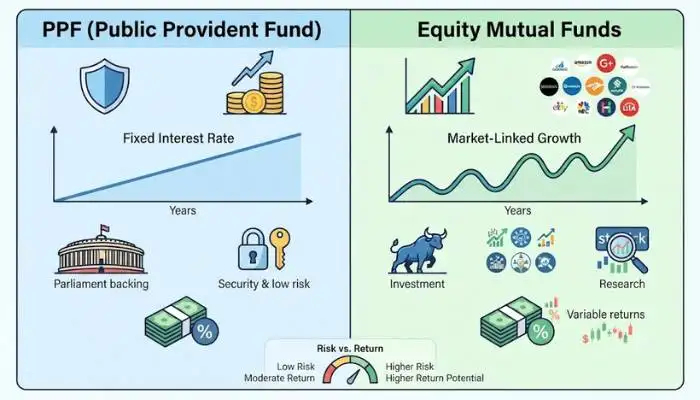
Returns
- PPF gives fixed returns. Currently 7.1% per annum . This rate is reviewed every quarter. But it has remained stable in recent years.
- Mutual funds give market-linked returns. Equity funds have historically given 10-14% over long periods . But returns can be negative in some years.
Example: If you invest ₹10,000 per month for 15 years in PPF at 7.1%, you get about ₹40.68 lakh . The same amount in an equity SIP at 12% gives about ₹63.06 lakh .
Risk
- PPF has zero risk. It is backed by the government. Your capital is safe. You know exactly how much you will get.
- Mutual funds carry market risk. The value can fall. In bad years, you might see a 20-30% drop. But over long periods, markets have recovered and grown .
Lock-in Period
- PPF has a 15-year lock-in. You cannot withdraw your full money before this period. Partial withdrawals are allowed after 6 years .
- Most mutual funds have no lock-in. You can withdraw anytime. ELSS funds have a 3-year lock-in .
Tax Treatment
- PPF is EEE - Exempt, Exempt, Exempt. Investment, interest, and maturity are all tax-free .
- Mutual funds are taxed differently. For equity funds, long-term gains above ₹1.25 lakh are taxed at 12.5%. Short-term gains are taxed at 20% .
Investment Limit
- PPF has a maximum limit of ₹1.5 lakh per year . You cannot invest more.
- Mutual funds have no upper limit. You can invest as much as you want.
Costs
- PPF has no charges. You pay nothing to invest .
- Mutual funds charge an expense ratio. This is a small percentage of your investment. It covers fund management costs.
PPF vs Mutual Fund Calculator: How to Compare
You can use online calculators to compare PPF and mutual fund returns. These tools show you the potential maturity amount for each option.
- PPF Calculator: Enter your yearly investment and tenure. The calculator uses the current PPF rate (7.1%) to show your maturity amount.
- SIP Calculator: Enter your monthly investment, expected return, and tenure. The calculator shows your potential corpus.
Example comparison: If you invest ₹12,500 per month (₹1.5 lakh per year) for 15 years:
- PPF at 7.1%: About ₹40.68 lakh
- Equity SIP at 12%: About ₹63.06 lakh
The SIP gives more. But the PPF amount is guaranteed. The SIP amount depends on market performance.

Mutual Funds vs PPF Which is Better for Long Term
- For long-term wealth creation, equity mutual funds have historically given higher returns. The power of compounding works better with higher returns.
- But higher returns come with higher risk. Markets can be volatile. You might see losses in some years.
- PPF is better for safety. Your money grows steadily. You do not worry about market crashes. You know exactly what you will get.
- Experts suggest using both. PPF acts as the safe anchor of your portfolio. Mutual funds provide growth. Together, they balance risk and return .
You May Also Read: Best Healthcare Mutual Fund Investment Ideas for Safe Growth
PPF vs Mutual Fund After Tax
This is an important comparison. Let us look at post-tax returns.
- PPF returns are completely tax-free. If you earn 7.1%, you keep all of it.
- Mutual fund returns are taxed. For equity funds held over 12 months, gains above ₹1.25 lakh are taxed at 12.5% . So if you earn 12%, your post-tax return is lower.
- But even after tax, equity mutual funds have historically outperformed PPF over long periods. The higher returns more than make up for the tax .
- For debt mutual funds, gains are taxed as per your income slab. This makes them less tax-efficient than PPF.
Who Should Choose PPF?
PPF is good for you if:
- You want guaranteed, risk-free returns
- You are a conservative investor
- You want tax-free income
- You do not need the money for 15 years
- You want to save for retirement
PPF works like the anchor of a conservative portfolio. It rewards patience and offers attractive risk-adjusted returns with zero credit risk .
Who Should Choose Mutual Funds?
Mutual funds are good for you if:
- You want higher returns over the long term
- You can handle market ups and downs
- You want flexibility to withdraw anytime
- You have a long time horizon (10+ years)
- You want to build wealth for goals like retirement or a house
Mutual funds are ideal if you want higher growth, flexibility, and the freedom to choose your asset mix .
The Best Approach: Use Both
Most experts recommend using both PPF and mutual funds. Here is why.
- PPF gives you safety. It protects your capital. It gives tax-free returns. It is your financial foundation.
- Mutual funds give you growth. They help you build wealth over time. They beat inflation. They give higher returns than fixed-income options.
A good strategy is to put some money in PPF for safety. Put the rest in mutual funds for growth. The exact split depends on your age and risk appetite.
Young investors can put more in mutual funds. Older investors should put more in PPF. As you near retirement, shift more money to safe options like PPF.
Quick Summary Table
| Feature | PPF | Mutual Funds |
|---|---|---|
| Returns | Fixed (7.1%) | Market-linked (10-14% historically) |
| Risk | Zero | Moderate to High |
| Lock-in | 15 years | None (3 years for ELSS) |
| Tax | EEE (fully tax-free) | LTCG 12.5% above ₹1.25 lakh |
| Limit | ₹1.5 lakh per year | No limit |
| Costs | None | Expense ratio |
| Best for | Safety and tax-free income | Long-term wealth creation |
FAQs
1. Which gives better returns - mutual funds or PPF?
Mutual funds have historically given higher returns (10-14%) compared to PPF (7.1%). But returns are not guaranteed in mutual funds.
2. Is PPF safer than mutual funds?
Yes. PPF is government-backed with zero risk. Mutual funds carry market risk. Your capital can fall in value.
3. Can I withdraw from PPF before 15 years?
Partial withdrawals are allowed after 6 years. Premature closure is allowed after 5 years only in special cases like medical emergency or higher education .
4. Which is better for tax saving - PPF or mutual funds?
PPF is fully tax-free (EEE). ELSS mutual funds qualify for Section 80C deduction but gains are taxed at 12.5% above ₹1.25 lakh. PPF is more tax-efficient.
5. Should I invest in both PPF and mutual funds?
Yes. Most experts recommend using both. PPF provides safety and stability. Mutual funds provide growth. Together they balance your portfolio.
6. What is the PPF interest rate for 2026?
The PPF interest rate is 7.1% per annum for the July-September 2026 quarter. It has remained unchanged .
7. How much can I invest in PPF per year?
Minimum ₹500 and maximum ₹1.5 lakh per year. You cannot invest more than this limit .
8. Can I stop my mutual fund SIP anytime?
Yes. Mutual fund SIPs are flexible. You can stop, pause, or change your SIP amount anytime. There is no penalty.
9. Which is better for retirement - PPF or mutual funds?
Both have a role. PPF gives safe, tax-free returns for stability. Mutual funds give growth to beat inflation. Use both for a balanced retirement portfolio.
10. What is the lock-in period for ELSS mutual funds?
ELSS funds have a 3-year lock-in. This is the shortest among all Section 80C options .