



401k to Invest in Real Estate: Complete Guide 2026
You have money sitting in your 401k. You want to use it to buy property. Maybe a rental flat. Maybe land. The idea sounds simple. But the rules are strict. One wrong move can cost you thousands in taxes and penalties. This is why learning 401k to invest in real estate matters before you act. There are smart ways to do it. There are also very costly mistakes.
This guide covers the best 401k to invest in real estate options. We show how to convert 401k to real estate without penalty. We answer can you use 401k to buy land without penalty. We also explain self-directed 401k real estate rules. And we answer should I cash out my 401k to buy rental property.
What is 401k to Invest in Real Estate?
Your 401k is retirement money. It sits in an account from your job. Real estate is property. Flats, houses, land. So using your 401k for real estate means putting retirement savings into property. But you cannot do this with a normal 401k. Most plans only let you buy stocks and funds. To buy property, you must move the money into a Self-Directed IRA or Solo 401k first. Then that account buys the property.
Your money keeps growing without tax until you retire. No tax hit. No penalty. If you take cash out instead, you lose a lot. Taxes plus a 10% penalty. So always do a direct rollover. Never withdraw. That is the safe path.
Read More: FHA Loan Requirements in 2026: Credit, Income and Down Payment
Can You Use Your 401k to Buy Real Estate?
The short answer is no, not directly. Your employer-sponsored 401k does not allow you to buy property. Most 401k plans only let you invest in stocks, bonds, and mutual funds .
But there are ways to use your retirement money for real estate. You just need to follow the right path.
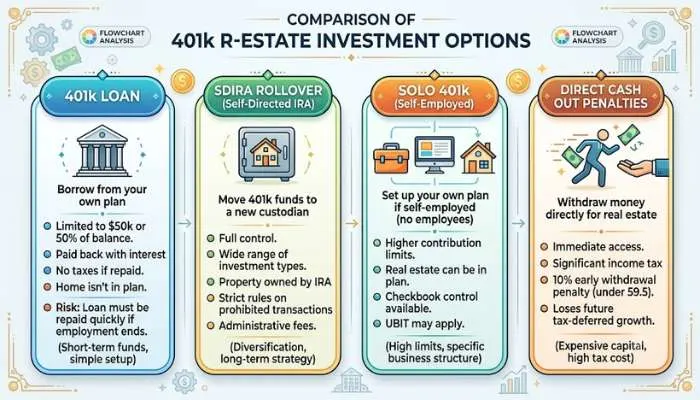
The Four Main Options
Option 1: 401k Loan
A 401k loan lets you borrow from your own account. You pay yourself back with interest through payroll deductions .
How it works:
- You can borrow up to $50,000 or 50% of your vested balance, whichever is less
- You have up to 5 years to repay
- No credit check needed
- The borrowed amount is not taxable if you repay it
The risk: If you leave your job, the loan may become due immediately. If you cannot repay, the unpaid balance counts as a distribution. You owe income tax plus a 10% penalty if you are under 59½ .
This option works for a down payment on a primary home. But it is not ideal for investment property. The repayment timeline is short, and the job-change risk is real.
Option 2: Rollover to Self-Directed IRA (SDIRA)
This is the most common path for real estate investors. You roll your old 401k into a Self-Directed IRA. Then you use the IRA to buy property .
Why it works:
- No taxes or penalties on the rollover
- You can buy rental properties, land, commercial buildings, and more
- Income and gains grow tax-deferred (or tax-free in a Roth SDIRA)
- You make all investment decisions
How to do it:
- Open a Self-Directed IRA with a custodian that allows real estate
- Ask your 401k plan administrator for a direct rollover
- The funds go directly to your SDIRA custodian
- Your IRA buys the property
Important: Only old 401k plans from past employers can be rolled over. If you are still with your current employer, you may not be eligible .
Option 3: Solo 401k
If you are self-employed or a business owner with no full-time employees, you can open a Solo 401k. This is a self-directed plan that allows real estate investment .
Key benefits:
- Higher contribution limits (up to $70,000 in 2025, $77,500 if over 50)
- Can invest in rental properties, commercial real estate, land, and tax liens
- Tax-deferred growth
The rules are strict:
- No personal use of the property
- All income and expenses must flow through the 401k
- You cannot do work on the property yourself (no sweat equity)
- All repairs and maintenance must be done by third parties
Option 4: Cash Out (Not Recommended)
You can withdraw money from your 401k. But this is the worst option.
What happens:
- You pay ordinary income tax on the amount
- You pay a 10% early withdrawal penalty if under 59½
- You lose future growth on that money
Important: The first-time homebuyer exception does not apply to 401k withdrawals. It only applies to IRAs . So you cannot avoid the penalty by claiming it is for a first home.
Verdict: Do not cash out. The tax hit is too big.
Best 401k to Invest in Real Estate
The best 401k to invest in real estate is a Self-Directed IRA or Solo 401k. Here is why.
- Self-Directed IRA: Best for most people with old 401k funds. It is simple to set up. You can invest in almost any property type. The income grows tax-deferred until retirement .
- Solo 401k: Best for self-employed individuals. Higher contribution limits. More control. But stricter rules on personal use and sweat equity .
- Regular 401k: Not suitable. You cannot buy property directly. You can only invest in REITs through mutual funds if your plan offers them .
How to Convert 401k to Real Estate Without Penalty?
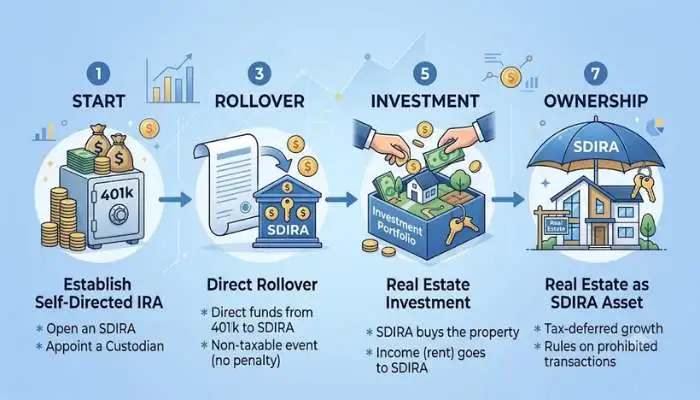
The key is a direct rollover. Here is the process :
- Step 1: Check if you are eligible. You can only roll over 401k funds from a former employer. Current employer plans may not allow it .
- Step 2: Open a Self-Directed IRA with a custodian that supports real estate.
- Step 3: Ask your 401k administrator to send the funds directly to your SDIRA custodian. Do not let them send the money to you.
- Step 4: Once the funds are in your SDIRA, you can buy property.
Why direct rollover matters: If the money goes to you first, the plan must withhold 20% for taxes. You have 60 days to deposit the full amount into your IRA. If you miss the deadline, the entire amount becomes taxable .
A direct rollover avoids all this. No taxes. No penalties. No withholding.
You May Also Read: Interest Rates and Housing Market Forecast for 2026
Can You Use 401k to Buy Land Without Penalty?
Yes, with a Self-Directed IRA or Solo 401k. Land is an eligible investment for these accounts .
The rules for land:
- The land must be held for investment, not personal use
- You cannot build a vacation home on it for yourself
- All expenses (property tax, maintenance) must be paid from the IRA
- Any income (like farming leases) must go back to the IRA
The catch: You cannot use a regular 401k to buy land. You must roll over to a Self-Directed account first.
Should I Cash Out My 401k to Buy Rental Property?
No. Cashing out is almost always a bad idea.
Why:
- You pay income tax on the full amount
- You pay a 10% penalty if under 59½
- You lose decades of compound growth
- The withdrawal may push you into a higher tax bracket
Example: You withdraw $50,000 in your 30s. You pay maybe $15,000 in taxes and penalties. That $50,000 could have grown to $400,000 by retirement at 7% annual return. You traded $400,000 for $35,000 today.
Better option: Roll over to a Self-Directed IRA. Buy the rental property inside the IRA. No taxes. No penalties. The income and appreciation grow tax-deferred .
Self-Directed 401k Real Estate Rules
If you use a Self-Directed 401k or IRA for real estate, you must follow strict IRS rules. Breaking them can disqualify your entire account .
1. No Personal Use
You, your spouse, your parents, your children, and their spouses cannot live in, use, or benefit from the property . This is called a "disqualified person" rule. Violating it is a prohibited transaction.
2. All Income and Expenses Flow Through the Account
Rent payments go into the IRA. Property taxes, repairs, and insurance are paid from the IRA. You cannot pay expenses from your personal bank account. You cannot deposit rent into your personal account .
3. No Sweat Equity
You cannot do work on the property yourself. You cannot mow the lawn. You cannot paint the walls. You cannot fix the plumbing. All work must be done by unrelated third parties .
4. No Commingling
You cannot mix IRA funds with personal funds. Every dollar related to the property must flow through the IRA .
5. Non-Recourse Loans Only
If the IRA takes a loan to buy property, it must be a non-recourse loan. You cannot personally guarantee the loan. The lender can only look to the property for repayment .
Penalty for violations: The IRA loses its tax-exempt status. The entire account becomes taxable. You may owe penalties on top .
FAQs
1. Can I use my 401k to buy a house?
You can take a 401k loan for a primary residence. But you cannot use a regular 401k to buy investment property directly. You need a Self-Directed IRA or Solo 401k .
2. How do I convert my 401k to real estate without penalty?
Roll over your old 401k to a Self-Directed IRA. Do a direct rollover so the money goes from your plan administrator to the IRA custodian. No taxes. No penalties .
3. Can I use my 401k to buy land?
Yes, through a Self-Directed IRA or Solo 401k. The land must be for investment only. You cannot use it personally.
4. Should I cash out my 401k to buy rental property?
No. You will pay income tax plus a 10% penalty. You will lose future growth. Roll over to a Self-Directed IRA instead .
5. What is a Self-Directed 401k?
It is a retirement plan that lets you invest in alternative assets like real estate. It is usually structured as a Solo 401k for self-employed people .
6. Can I live in a property owned by my Self-Directed IRA?
No. You cannot live in it. Your spouse, parents, children, and their spouses cannot live in it either. This is a prohibited transaction.
7. What happens if I break the Self-Directed IRA rules?
Your IRA loses its tax-exempt status. The entire account becomes taxable. You may owe penalties .
8. Can I manage the property myself in a Self-Directed IRA?
You can make decisions. But you cannot do physical work. You cannot collect rent into your personal account. You must hire third parties for maintenance and repairs .