



Difference Between Market Order and Limit Order Explained
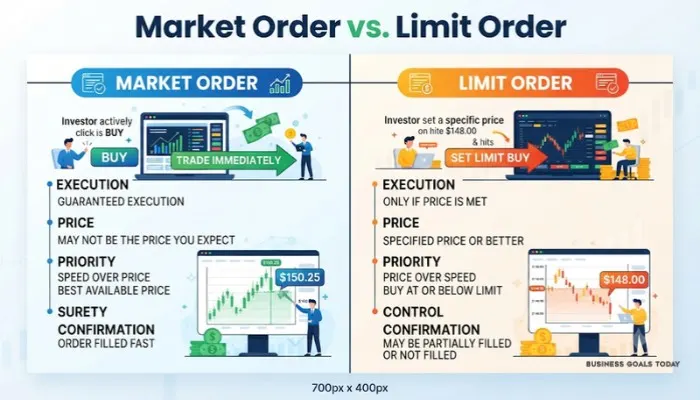
The difference between a market order and a limit order comes down to one simple trade-off. A market order gets the trade done fast, but you do not control the price. A limit order gives you price control, but the trade might not happen at all.
What Is a Market Order?
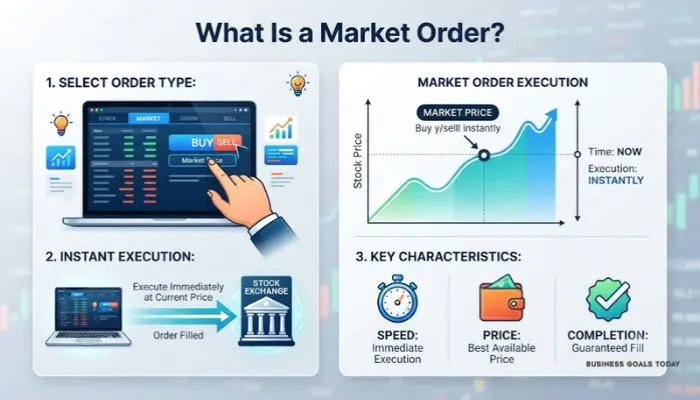
A market order tells your broker to buy or sell immediately at the best available price . You are prioritising speed over price.
Market order example: You want to buy 100 shares of a stock currently trading at ₹500. You place a market order. The exchange finds sellers. If there are only 60 shares available at ₹500 and the rest are at ₹502, you get 60 shares at ₹500 and 40 shares at ₹502. Your average price is ₹500.80, not ₹500 .
This gap between the price you saw and the price you got is called slippage . It happens most in fast-moving markets or stocks with low trading volume.
What Is a Limit Order?
A limit order tells your broker to buy or sell only at a specific price or better . You are prioritising price over speed.
Limit order example: The same stock is at ₹500. You place a buy limit order at ₹490. The order sits pending. It will only execute if the price drops to ₹490 or lower . If the price never drops, the order expires unfilled. You do not get the shares, but you also do not pay more than you wanted.
Read More: How to Protect Stock Portfolio During Market Crash: Simple Guide
Difference Between Market Order and Limit Order in Stock Market
| Feature | Market Order | Limit Order |
|---|---|---|
| Price control | None. You take whatever price the market gives . | Full. You set the maximum buy price or minimum sell price . |
| Execution speed | Immediate, as long as buyers or sellers exist . | Only when the market reaches your price. Could be minutes, days, or never . |
| Execution guarantee | Almost always executed . | Not guaranteed. May remain unfilled . |
| Main risk | Slippage. You might pay more or receive less than expected . | No trade. You might miss the opportunity entirely . |
| Best for | Highly liquid large-cap stocks, urgent trades, intraday trading . | Volatile markets, illiquid stocks, long-term investors who want a specific entry price . |
Difference Between Market Order and Limit Order with Examples
The clearest way to see the difference is to compare what happens with the same stock.
- Scenario: You want to buy 1,000 shares. The stock is quoting at ₹500.
- Market Order: You place a market buy. The order book shows 400 shares at ₹500, 350 at ₹502, and 250 at ₹505. You get all 1,000 shares. Your average price is ₹501.95. You paid ₹1.95 more per share than the quote you saw .
- Limit Order at ₹500: You place a buy limit at ₹500. Only the 400 shares available at ₹500 get filled. The remaining 600 shares stay pending. If the price moves up and never comes back, you end up with only 400 shares .
When to Use Which?
- Use a market order when: The stock is highly liquid (like large caps such as Reliance or HDFC Bank), you need to enter or exit immediately, and a small price difference does not matter to you .
- Use a limit order when: You want a specific entry or exit price, the stock is thinly traded, or the market is volatile and you want protection from a sudden spike .
For beginners, limit orders are often safer. They stop you from paying a crazy price in a fast market. But they also mean you might miss a trade if the price runs away from you.
FAQs
1. What is a limit order in simple words?
A limit order is an instruction to buy or sell only at a price you choose or better. If you set a buy limit at ₹100, you will not pay more than ₹100. If the price never drops to ₹100, the order does not execute .
2. What is a market order example?
You place a market buy for 100 shares at the current price of ₹500. The exchange fills your order at the best available prices. You might get some shares at ₹500 and some at ₹501, depending on what sellers are asking .
3. Which is better, market or limit order?
Neither is always better. It depends on your goal. Market orders are better when speed matters and the stock is liquid. Limit orders are better when price control matters and you can wait .
4. What is the main risk of a market order?
Slippage. In a fast-moving market, the price you get can be worse than the price you saw on screen. This is especially true for large orders or stocks with low volume .
5. What is the main risk of a limit order?
The order might never execute. If the market never reaches your price, you do not get the trade. You could miss a big move while waiting for a better price .
6. Can I use limit orders for intraday trading?
Yes, but be careful. In fast markets, a limit order might not fill, and you could miss the move. Many intraday traders use market orders for speed. Limit orders work better when you are not in a rush .
7. What happens if my limit order is partially filled?
If there are not enough shares available at your limit price, your order may be partially filled. The rest stays pending. If the price moves away, the remaining shares stay unfilled .
8. Do I pay different charges for market vs limit orders?
No. Brokerage and taxes are the same. The difference is only in how the order executes. Your profit or loss changes because of the execution price, not the order type .